The Writing
Two shelves, organised by series.
Every book belongs to a shelf, fiction or nonfiction, and may belong to a series within it. Only published work is listed here.
Nonfiction
1 published title
Further nonfiction series are in development.
Fiction
No titles announced yet
Fiction series are in development. Titles will be listed here when they are announced.
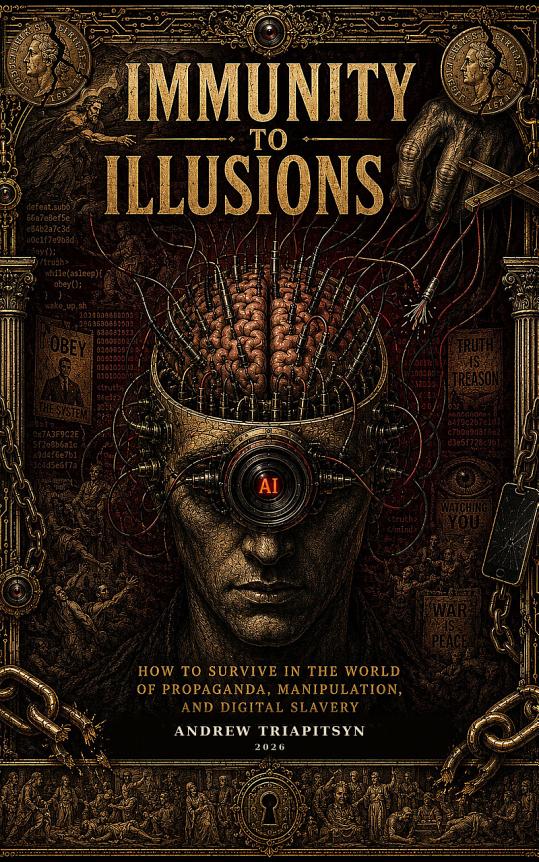
Featured title · Nonfiction
Immunity to Illusions
How to Survive in a World of Propaganda, Manipulation, and Digital Slavery
“This is not a book about other people’s gullibility.”
A systematic investigation into how modern environments shape perception, not mainly through censorship but through design: platforms, institutions, incentives and the vocabulary we are given to think with.
It applies the same scrutiny to every side, including the reader’s own. What it offers in return is not a new allegiance, but a sharper and more independent judgment.
- Format
- Ebook
- Length
- 13 chapters · 786 pages (Google Play)
- Includes
- 70 original illustrations, a personal Capture Audit, and practical reasoning exercises
- Published
- August 2026 · Andrew Triapitsyn, Ireland
- ISBN
- 978-1-0668524-4-4
Inside the book
The machinery it takes apart.
Territory covered across the thirteen chapters, summarised from the book’s description. These are subjects, not chapter titles.
- AttentionEngineered addiction and the attention economy.
- SufferingHow distress is converted into currency.
- HealthWellbeing repackaged as a commodity, and medicine sold on subscription.
- EducationCredentials issued without comprehension.
- PowerAuthority that manages the conditions under which truth appears.
- SurveillanceThe algorithmic eye that never closes.
Inspect the frame
Question what shapes what you see.
An interactive diagram of the book’s method of examination: an interpretation, not an excerpt. Move inward one layer at a time.
Layer 1 of 5 · Surface
What appears: a feed, a headline, a choice that feels like your own.
Ask What is being shown, and what has been left outside the frame?
Layer 2 of 5 · Design
How it is arranged: defaults, sequences and friction that make some choices effortless and others unnatural.
Ask What does this make easy, and what does it make hard?
Layer 3 of 5 · Incentive
Who benefits: attention, dependence and revenue that reward the arrangement.
Ask Who gains if I believe this, click this, or stay?
Layer 4 of 5 · Language
What can be said: a vocabulary that quietly narrows the questions it is possible to ask.
Ask Which words am I given, and which questions do they rule out?
Layer 5 of 5 · Yourself
The layer scrutiny most often skips: what you already want to be true.
Ask Would I accept this argument if it favoured the other side?
From argument to evidence
The book begins the inquiry. The sources let you continue it.
Every numbered reference in Immunity to Illusions resolves on its research companion, a separate site maintained by the author. Browse by chapter, follow each link to its origin, and judge the evidence yourself.
Open the sources companion at illusionsbook.com (opens in a new tab)- 50numbered research sources, keyed to the text
- 31recommended films, documentaries and series
- 13chapters to browse by, plus a section before you begin
Continue reading
Examine the claims. Follow the evidence. Make up your own mind.
-
Start
Read a free sample
Open Immunity to Illusions on Google Play and choose “Free sample”.
Google Play listing (opens in a new tab) -
Own it
Buy the ebook
Available as an ebook from Google Play Books.
Buy on Google Play (opens in a new tab) -
Verify
Check the sources
The research and recommended viewing behind the book.
illusionsbook.com (opens in a new tab) -
Write
Contact the author
Write to Andrew at the address he lists publicly.
andrew.books@pm.me